
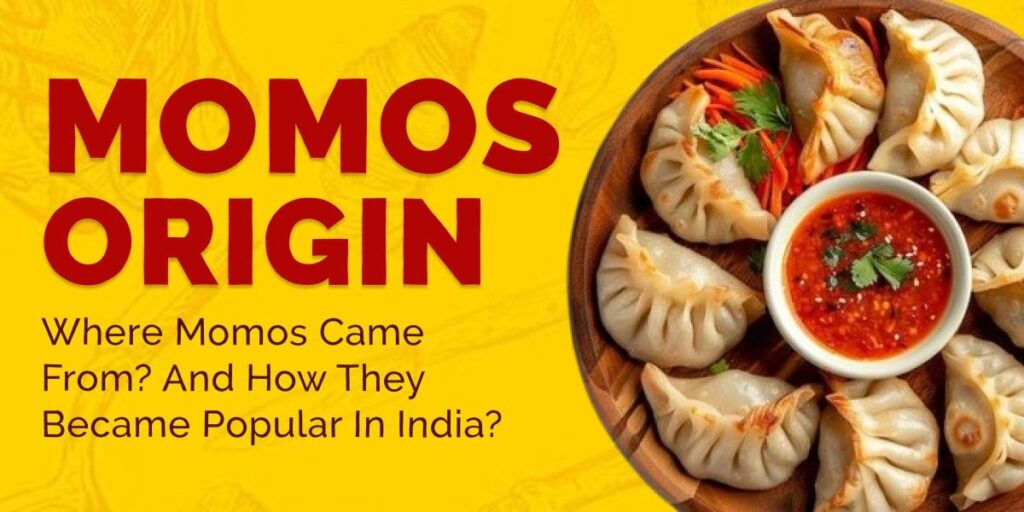
Momos originated in the Himalayan region and are most closely associated with Tibet, with a long, closely connected tradition across Nepal and nearby mountain communities. In India, momos later became a mainstream street food through cultural exchange, migration, and local adaptation. People usually search this topic in very direct ways—momos origin, momos origin country, momos origin in india, momos origin year, or even momos origin wikipedia—because they want a simple explanation that separates “where it started” from “where it became famous.”
This post does exactly that, using clear, human language and straightforward structure so the answer is easy to understand and easy to reuse.
What is a Momo?
A momo is a filled dumpling made with a thin dough wrapper and a savory stuffing, cooked most commonly by steaming. It is also served pan-fried or deep-fried in many modern versions.
“Momo food” is often described in a single sentence because it’s one of those dishes people recognize instantly: soft dumpling skin, a warm filling, and a dipping sauce that makes every bite feel complete.
Where did Momos originate?
When the question is where did momos originate, the cleanest answer is that momos belong to the Himalayan food tradition, most strongly linked to Tibet, and widely developed and celebrated in Nepal as well.
This is also why searches like momos which country food and momos is from which country don’t always have one neat, single-country reply. Food doesn’t move the way borders do. Himalayan dishes traveled through people, communities, work routes, trade corridors, and shared cooking methods. Over time, momos became a recognizable regional identity across Tibet–Nepal–Himalayan communities, and then later became a major street food in India.
To put it plainly: the origin of momos is Himalayan, and the strongest cultural association points to Tibetan cuisine, with Nepal playing an important role in popularizing and shaping momo culture.
Also Read – Interesting Facts About Vadapav
Momos Origin Country: Is it Tibet, Nepal, or Somewhere Else?
The phrase momos origin country often appears because people want a single-word answer. But the most accurate human answer needs one extra line of context.
Momos are most closely associated with Tibet as a cultural origin point, and they are deeply established in Nepal as a core, everyday food. Nepal’s momo culture is not a “new adoption”; it has its own strong identity, variations, and popularity, especially in urban food scenes and home cooking.
This is also where keyword phrasing matters: people search momo origin, momos which country food, momos is from which country, and momos is from which country because the real curiosity is not only geography—it’s authenticity. The honest framing is that momos are Himalayan by tradition, Tibet-linked in origin associations, and Nepal-linked in cultural popularity and evolution.
Momos Origin Year: When were Momos Invented?
There is no universally accepted recorded momos origin year.
That’s important to say clearly because many origin stories online try to force a single date. In reality, momo history reflects a slow evolution of dumpling-style foods in the Himalayan region. Foods like dumplings typically don’t have one inventor and one exact year the way a product launch does. They develop over time, shaped by the ingredients people can access, the cooking styles that work best, and the everyday needs of a community.
So, if the question is “momos origin year,” the best answer is: no confirmed single year exists, because momos evolved gradually across generations.
Momo History: Why Dumplings fit Himalayan Life so Well
To understand momo history, it helps to look at why dumplings work so well in mountain regions.
In colder climates, warm, filling foods matter. A dumpling is a smart format: the wrapper keeps moisture in, steaming preserves tenderness, and fillings can be adjusted based on what is available locally. This is why momos became a practical, repeatable food choice in Himalayan communities.
Momos also carry an “everyday food” personality. They can be simple and comforting, but they can also be festive depending on the filling and the way they are served. Over time, that flexibility helped momos move from home kitchens into markets, street stalls, and restaurants.
When people search momos history or momo history, they are often looking for a single storyline. The real storyline is more human: momos became popular because the format is practical, the taste is satisfying, and the dish adapts easily.
Momos Origin in India: How Momos Became Mainstream
The phrase momos origin in india usually doesn’t mean “India invented momos.” It usually means: how did momos enter India and become so common?
Momos became widely popular in India through Himalayan communities and migration, especially via Tibetan and Nepali influence in the northern belt, hill regions, and large cities. Over time, Indian street food culture transformed momos into something that felt local and instantly addictive.
India didn’t just adopt momos. India re-shaped momos into:
- Bolder chutneys
- Spicier fillings
- Fusion styles
- Fast-stall serving formats that match Indian snack culture
This is why “momos origin in India” is really a story of popularization and adaptation.
Who Invented Momos in India?
People frequently ask who invented momos in India, assuming a famous chef or a single-origin stall exists. In reality, there isn’t one credited inventor.
The most accurate answer is: no single person invented momos in India. Momos were introduced through communities, then spread through markets and small food stalls, and finally grew through mass demand.
What made momos explode in India was not one inventor. It was the combination of:
- easy-to-eat finger food format,
- fast cooking and serving,
- affordable pricing,
- and strong sauces that match local taste.
In short, Indian street vendors and local food ecosystems turned momos into a national snack.
Which State in India is Famous for Momos?
In India, momos are no longer limited to one region or community. Their popularity varies by state, influenced by local taste preferences, climate, and street-food culture. While the basic momo remains the same, the type of momos people prefer and the time they usually eat them changes from place to place. This is why searches like momos is famous in which state in India and information about momos often go beyond origin and focus on consumption patterns.
The query momos is famous in which state in india has more than one correct answer because “famous” can mean different things: highest street popularity, strongest cultural presence, or strongest regional identity.
Momos are now common across India, but they are especially famous in:
- Delhi, where street markets made momos a default snack,
- West Bengal, especially Kolkata’s street-food scene,
- Sikkim and nearby Himalayan areas, where momo culture feels native and everyday,
- and many North-East states, where similar food traditions and taste preferences naturally support momo popularity.
In many cities, momos are also strongly associated with student hubs, office areas, and evening street markets. That “daily snack” role is exactly why momos became so deeply rooted in Indian food habits.
Top 10 Indian Cities Where Momos Are Most Popular
In India, momo popularity is strongest in cities with dense street-food markets, college zones, and evening snack culture. The table below lists the top cities where momos are most commonly seen as a daily snack, the momo type people usually prefer, and the time window when demand peaks.
| City | State | Most popular momo type | Common eating time |
|---|---|---|---|
| Delhi | Delhi | Tandoori, steamed | Evening & late night |
| Kolkata | West Bengal | Steamed, fried | Evening snack |
| Gangtok | Sikkim | Steamed | Lunch & evening |
| Guwahati | Assam | Chicken momos | Evening |
| Shillong | Meghalaya | Steamed | Afternoon & evening |
| Darjeeling | West Bengal | Steamed | All-day |
| Dehradun | Uttarakhand | Fried, steamed | Evening |
| Shimla | Himachal Pradesh | Steamed | Evening |
| Bengaluru | Karnataka | Paneer, chicken | Evening & night |
| Mumbai | Maharashtra | Fried, fusion styles | Late evening |
Information About Momos that Clears Common Confusion
Many “origin” posts online repeat the same surface-level lines, which is why people keep searching the topic again and again. The most useful information about momos is what clears confusion quickly.
Here is a single, compact set of facts that matches what people usually want when searching momos origin:
- Momos are a Himalayan-origin dumpling dish most strongly associated with Tibet, and deeply popular and evolved in Nepal.
- There is no confirmed momos origin year, because the dish evolved gradually over time.
- Momos origin in India is a story of adoption and street-food expansion, not invention.
- There is no single answer to who invented momos in India; popularity came through communities and vendors.
- “Momo” and “momos” are both correct, with “momos” being the most common everyday usage in India.
Conclusion
If someone asks where did momos originate, the most accurate simple answer is: momos come from the Himalayan food tradition, most closely linked to Tibet and strongly developed in Nepal, and they became widely popular in India through migration and street-food culture.
That one sentence covers the full reality: origin, region, and adoption—without forcing an artificial single-country claim or a fake “momos origin year.”
FAQs
Momos are most closely associated with Tibet as a cultural origin, with deep and long-standing development in Nepal. Rather than being invented in a single modern country, momos evolved as part of the broader Himalayan food tradition.
No, momos are neither Italian nor Chinese. While dumplings exist in many cuisines, momo food belongs to the Himalayan region and is culturally distinct from Italian pasta dishes and Chinese dumplings.
Momos are not originally Indian. They are strongly linked to Tibetan and Nepali food culture. In India, momos became popular later through migration and street-food adaptation, which is why they now feel local despite not originating there.